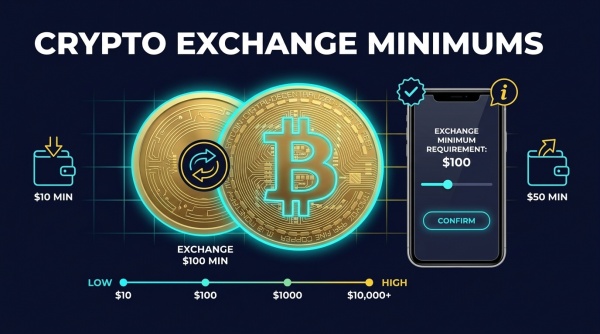
You've set up a conversion on an instant exchange, entered your details, and then hit a wall: "amount below minimum." The transaction won't proceed. Why? What's the minimum? And how do you know before you waste ten minutes setting everything up?
This is one of the most common friction points for people using crypto exchange services for the first time — and it's rarely explained well. Here's the full picture.
Why Minimums Exist
Instant crypto exchanges aren't charities. They have costs: blockchain network fees, liquidity management, payment processing, and operational overhead. For very small transactions, those fixed costs can exceed the margin the platform makes on the exchange.
Minimum transaction amounts help make sure each conversion is practical to process. They can also protect users from making very small transactions where network or processing fees could take an unnecessarily large share of the amount being exchanged.
The important thing is that a minimum isn't necessarily the same for every cryptocurrency pair. Different assets, payment methods, networks, and liquidity conditions can result in different minimum requirements.
What Minimums Actually Look Like
Minimums can be set in several ways. Some exchanges use a fixed dollar value, while others use a minimum quantity of a particular cryptocurrency. In some cases, the required amount depends on the exact exchange pair.
With Boohttps://boomchange.com/mchange, there isn't one universal minimum that applies to every transaction. Depending on the pair you're using, the minimum can be 50 USDT, 100 USDT, or 200 USDT.
That means checking the minimum for the specific pair before starting the transaction is important. For example, a pair with a 50 USDT minimum can be used at a lower amount than another pair requiring 100 USDT or 200 USDT.
This pair-based approach is more useful than assuming that one minimum applies across the entire platform.
Why Different Pairs Have Different Minimums
There isn't necessarily a single reason why one pair has a 50 USDT minimum while another requires 100 or 200 USDT.
Different cryptocurrencies and payment destinations can involve different processing costs, liquidity conditions, network requirements, and settlement arrangements. Some routes are simply more expensive or complicated to process than others.
For users, the practical takeaway is simple: don't assume that because one Boomchange pair accepts 50 USDT, every other pair will accept the same amount.
The minimum shown for the exact route you're using is the number that matters.
Minimums by Asset Type — What to Watch For
Stablecoins such as USDT and USDC can make it relatively easy to understand the minimum because their values generally remain close to the U.S. dollar. If a particular route has a 50 USDT minimum, for example, you can immediately understand approximately how much value needs to be entered.
Bitcoin works differently because its price changes constantly. The minimum may be displayed in the required currency or asset equivalent, so the amount of BTC needed can change as the market price moves.
Ethereum and ERC-20 tokens require another consideration: network fees. Even if the transaction meets the exchange's minimum, sending a small amount of a token over Ethereum may involve additional network costs.
High-supply tokens such as DOGE or SHIB can also look confusing because reaching a dollar-denominated minimum may require a large number of individual tokens. In these cases, focus on the value of the transaction rather than simply looking at the number of coins.
What Happens If You Send Below the Minimum?
This varies by exchange and transaction route.
In some situations, an exchange will prevent you from creating the transaction if the entered amount doesn't meet the minimum. This is the easiest scenario because you can correct the amount before sending anything.
Other situations can be more complicated if funds are already sent and the received amount doesn't meet the applicable minimum. Depending on the platform and transaction, manual support may be required.
That's why checking the minimum before sending crypto is always preferable to discovering the requirement after the transaction has already been initiated.
With Boomchange, users should check the minimum displayed for their selected pair during the exchange setup and make sure the amount they intend to send satisfies that requirement.
Tips for First-Time Users
- Check the exact pair before sending.
Don't assume that every Boomchange transaction has the same minimum. Some pairs require 50 USDT, while others may require 100 USDT or 200 USDT. - Look at the transaction value, not just the token quantity.
This is particularly important with assets such as SHIB, DOGE, or other coins where the number of tokens can be very large compared with their dollar value. - Leave some room above the minimum when possible.
If your transaction is right on the threshold, price movements or changes in the asset's value can make the situation less straightforward. Sending an amount comfortably above the stated minimum can provide a little more room. - Consider network fees separately.
Meeting the exchange minimum doesn't mean network fees disappear. If you're transferring an asset over a network with significant fees, factor those costs into the amount you're planning to send. - Check the requirement before making the blockchain transfer.
The safest time to confirm the minimum is before you send anything. Select the pair, review the transaction requirements, and make sure your amount qualifies.
The One-Paragraph Summary
Crypto exchange minimums exist because very small transactions can be impractical to process once network, liquidity, and operational costs are considered. With Boomchange, there isn't one minimum that applies to every pair. Depending on the selected route, the minimum transaction amount can be 50 USDT, 100 USDT, or 200 USDT. Always check the requirement for the exact pair you're using, consider network fees, and confirm the minimum before sending your crypto.
Simple in principle. Just worth checking before you set anything up.