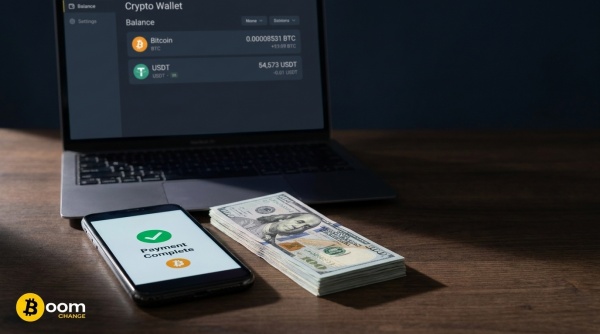
USDT sits in your wallet looking like a dollar and acting like a dollar. It is called a stablecoin precisely because it tracks the dollar one to one. But it is not cash yet. Before you can spend it or pay a bill, it has to pass through a conversion step, and for anyone new to crypto that step feels harder than it should be. Not because it is complicated, but because there are five genuinely different routes and nobody tells you upfront which one fits your situation.
This guide walks through each one in plain terms: what it costs, how fast it is, and when it makes sense, whether you are cashing out $50 or $5,000.
First, Decide What "Cash" Means for You
"Convert USDT to cash" means one of two things: a spendable dollar balance in an account you already use, or physical notes in your hand. Those goals point at different tools, and picking the wrong one is where beginners waste the most time.
Physical currency means a crypto ATM, with everything that implies about fees. A spendable balance gives you more options: an exchange, a peer-to-peer trade, a crypto card, or an instant exchange that pays straight into a payment service you already use. That last route is the one most guides skip, and for small to mid-size amounts it is often the fastest. Services like Boomchange, which converts USDT to cash in PayPal, Zelle, Cash App or a bank card, do the whole thing in one transaction rather than four. More on that below, after the routes you have probably already heard of.
Method 1: Sell on a Centralized Exchange, Then Withdraw
The standard beginner route: open an account on an exchange like Coinbase or Kraken, verify your identity, deposit your USDT, sell it for USD, then withdraw to your linked bank.
If you already have a verified account, this is the cheapest option above a few hundred dollars: roughly 0.1 to 0.5 percent in trading fees plus a $5 to $25 wire fee. The trade-off is time. It is the slowest route here, since the bank transfer alone takes one to three business days, and up to five in some regions. Starting from scratch adds the verification queue on top.
Method 2: Peer-to-Peer Trading
P2P platforms match you with someone who wants to buy your USDT, with escrow holding the crypto so neither side can walk off with both the coins and the money. You post an offer, a buyer accepts, they pay by bank transfer or mobile money, and you release the USDT once payment lands.
Cost is comparable to an exchange, roughly 0 to 2 percent, and it is usually faster, with a typical trade settling inside an hour. The catch is the stranger on the other side. Use the platform escrow every time, and never release crypto before payment is confirmed in the app. If a buyer pressures you to release early, that is the scam, not an exception to it.
Method 3: Crypto Debit Cards
A crypto card converts at the moment you tap or swipe, so it is less a cash-out method than a way to spend without a separate sell-and-withdraw step. The cost shows up at the ATM: about $1.50 to $3.50 in operator surcharge inside your free monthly tier, and roughly 2 percent from your issuer past it. Stablecoin cards carry almost no spread on the conversion itself, so nearly everything you pay is those stacked fees. Good for groceries, expensive for a lump sum.
Method 4: Crypto ATMs
The most literal version of cashing out: send crypto from your phone, wait for confirmation, collect notes. There are over 38,000 crypto ATMs worldwide, most built around Bitcoin rather than Tether. If the machine near you does not list USDT, you have to swap to Bitcoin first, which adds a step and a fee before you reach the machine.
Speed is the selling point: notes in hand in eight to fifteen minutes. The price is steep. The average US crypto ATM withdrawal costs 12 to 15 percent once you count the operator cut and the rate markup baked into the display. Most machines cap sells between $2,000 and $10,000 a day and ask for ID above roughly $250 to $900.
Method 5: Instant Exchange Direct to a Payment Service
This route fills the gap the other four leave open: dollars today, in an account you already use, without opening anything or waiting on verification. An instant exchange holds no balance for you and has no order book. You say what you are sending and what you want back, it quotes a rate, you send the USDT, it pays out. Boomchange has run this model since 2021, has processed over 25,700 exchanges, and pays out to PayPal, Zelle, Cash App, Skrill, Wise, Payoneer, Visa and Mastercard, usually in 10 to 20 minutes.
The step-by-step is short:
- Pick your pair. Choose USDT as what you are sending and your payout method as what you want back, then enter the amount.
- Check the quote. The rate and the exact payout figure appear before you commit. If the number does not work, walk away here.
- Enter your payout details. A PayPal email, a Zelle phone number, a card number. Read it back twice, because this is where delays come from.
- Send the USDT. The platform generates a deposit address. Once the network confirms, the conversion runs and the money goes out.
The minimum is $10, low enough to test the route with pocket change first. With no registration and no identity review, the clock starts when you send, not when a compliance team reaches your file.
It is not free. Instant exchanges price their margin into the quote rather than charging a separate visible fee, so the only number that matters is the payout figure on screen. Compare it against what an exchange leaves you after fees and a three-day wait.
Comparing the Five Routes
Cheapest for larger amounts: a centralized exchange, if you can wait out the bank transfer.
Fastest to a spendable balance: an instant exchange, 10 to 20 minutes, no account.
Best for everyday spending: a crypto card, where the conversion is near-free but ATM use is not.
Fastest to physical notes: a crypto ATM, at the highest cost on this list.
Safety Tips Every Beginner Should Know
A few habits keep you out of someone else’s cautionary forum post. Test any new platform with a small amount first. In a P2P trade, never release USDT until payment appears inside the platform, not in a chat message or a screenshot. Check that the network you are sending on matches what the receiving side expects, because USDT on the wrong network can be stranded permanently.
One more, specific to instant exchanges: a legitimate service generates a fresh deposit address for every order. If a site shows the same fixed address for two unrelated transactions, close the tab. That is a known signature of fake exchange sites.
Frequently Asked Questions
What is the cheapest way to convert USDT to cash? Above a few hundred dollars, a centralized exchange usually wins on pure cost. Crypto ATMs are the most expensive by a wide margin. Instant exchanges sit in between, and you are paying for the time you save.
How fast can I actually get my money? An instant exchange to PayPal, Zelle or Cash App takes 10 to 20 minutes. A P2P trade often settles within the hour. An exchange withdrawal takes one to three business days.
Can I convert USDT to cash without identity verification? Instant exchanges like Boomchange run without registration or KYC, and low-value ATM transactions often need only a phone number. Larger amounts on regulated platforms will require verification. Be sceptical of anyone promising unlimited anonymous cash-outs.
What is the smallest amount worth converting? Instant exchanges start from around $10. On a centralized exchange, fixed wire fees of $5 to $25 make anything under a couple of hundred dollars poor value.
The Bottom Line
There is no single best way to convert USDT to cash, only the best route for what you need right now. Several thousand dollars at the lowest fee points at an exchange. Notes tonight point at an ATM, expensive as it is. For the most common case, spendable dollars today in an account you already have, an instant conversion is the shortest path. If that is you, start a USDT cash-out on Boomchange from $10 and see the exact payout figure before you commit a cent. Learn the trade-offs once and every future cash-out becomes a five-minute decision instead of a research project.