If you went into any branch of Bank of America and asked your advisor about investing some money in Bitcoin, you would most likely receive a simple shrug. Officially, the company's attitude was that "they would discuss it with you if you mentioned it but do not really expect them to advise you to do so."
As of January 5, 2026, Bank of America gave the go-ahead to 15,000 wealth management advisors to recommend cryptocurrencies for their clients within the frameworks of Merrill, Bank of America Private Bank, and Merrill Edge. The difference is quite notable here. Cryptocurrencies became an integral part of the bank's approach to portfolio construction, while before it was just a topic that could be mentioned by a client first.
So How Much Bitcoin is Bank of America Actually Recommending?
The amount is small, and that's by design. Bank of America suggests the investment allocation between 1% to 4% of their total portfolio. As Chris Hyzy, the Chief Investment Officer at Bank of America Private Bank says, for those investors with a significant interest in thematic innovation and can handle highly volatile assets, this small portion can be considered reasonable.
At the same time, he mentions that the guidelines of the bank are revolving around regulated vehicles, proper allocation, and awareness of the opportunities and risks.
In other words, the bank is not suggesting putting all the eggs in one basket but a small piece of cake may do the trick.
Bitcoin ETFs, Not Direct Ownership
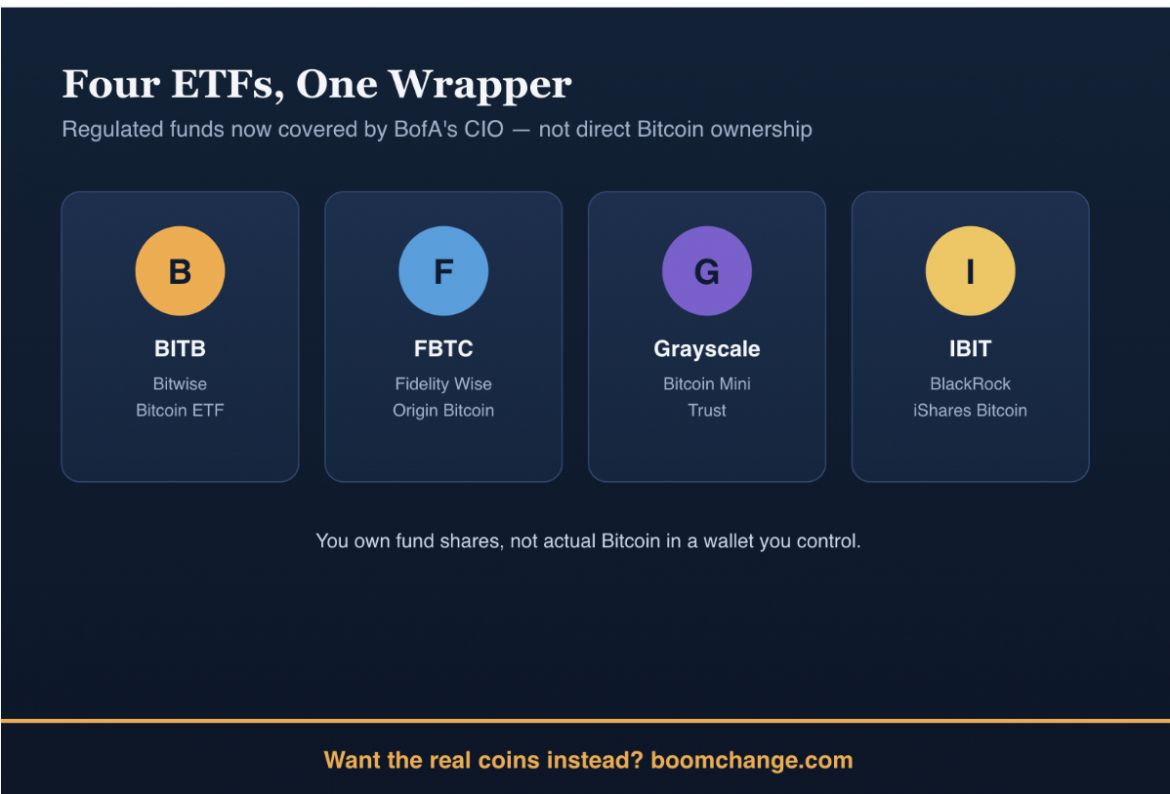
Here's an important detail people often miss. This isn't Bank of America handing out crypto wallets. Clients on Merrill, Private Bank, and Merrill Edge will be able to invest in Bitcoin through regulated exchange-traded products, with the bank backing four major Bitcoin ETFs: the Bitwise Bitcoin ETF, Fidelity's Wise Origin Bitcoin Fund, the Grayscale Bitcoin Mini Trust, and BlackRock's iShares Bitcoin Trust.
So the access is real, but it comes wrapped in the traditional finance structure: ETFs, custodians, regulatory oversight. You're not actually holding Bitcoin in a wallet you control. You own a share of a fund that tracks the price.
Why This Matters for the Bigger Picture
This isn't happening in a vacuum. Bank of America's move is part of a broader institutional shift that built up through late 2025 and into early 2026, with other major players like Morgan Stanley, BlackRock, and even the previously cautious Vanguard Group opening their doors to regulated crypto exposure. Morgan Stanley, for example, issued its own 2% to 4% recommendation for "opportunistic portfolios" back in October.
Put simply: the biggest names in American finance are quietly agreeing that Bitcoin deserves a small seat at the table.
But What If You Actually Want to Own Bitcoin, Not a Fund?
This is where the Bank of America story runs into its own limits. ETFs are convenient if you're already a Merrill or Private Bank client with a big enough portfolio to make a 1-4% allocation meaningful. But they're not for everyone. You don't actually hold the coins. You can't move them, send them, or use them the way crypto was originally meant to be used. And if you're not already a high-net-worth client of one of these banks, none of this applies to you anyway.
If what you actually want is to buy, hold, or exchange real Bitcoin, without going through a bank's wealth division or jumping through KYC hoops, that's a very different process. This is exactly the gap that platforms like Boomchange were built to fill.
Where Boomchange Fits in
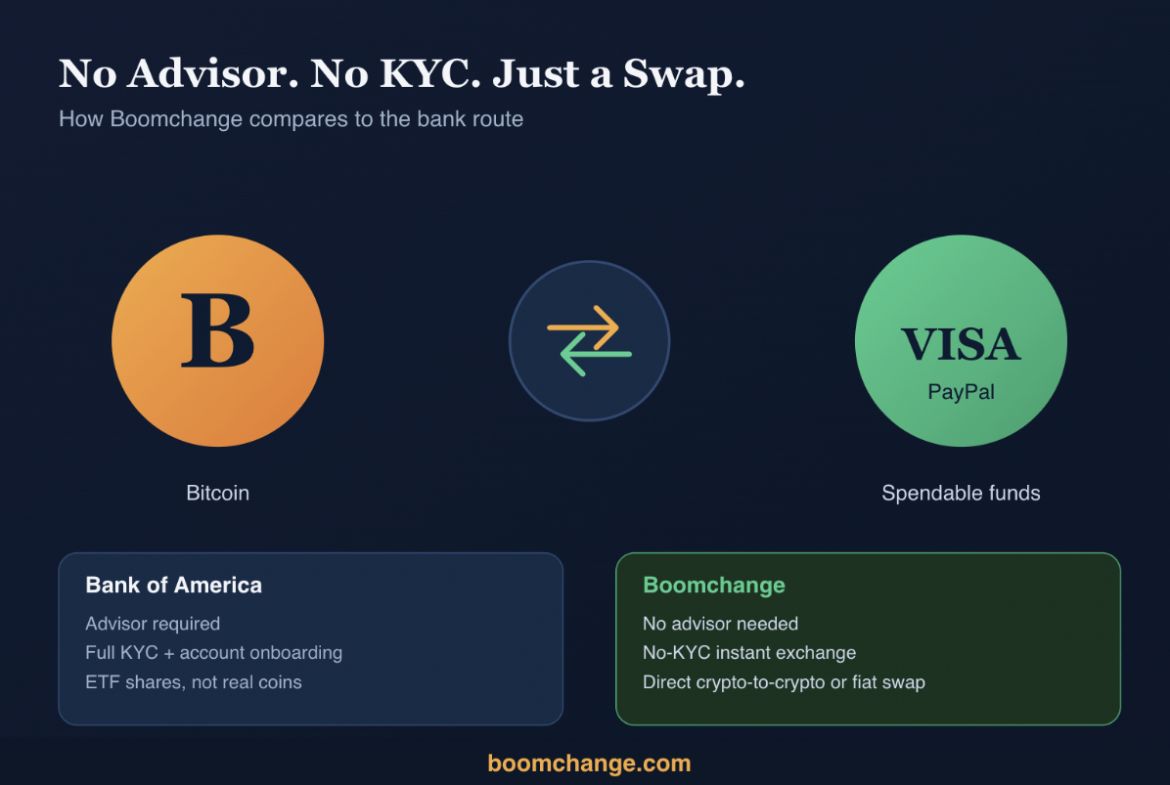
Boomchange is a no-KYC instant crypto exchange. Instead of opening an account, verifying your identity, waiting for approval, and then placing a trade through a financial advisor, you simply exchange the currency you have for the one you want, directly and quickly, without handing over a stack of personal documents.
That's a fundamentally different experience from what Bank of America is offering. Bank of America's new policy is built for clients who already have wealth management relationships and want a small, regulated slice of Bitcoin exposure inside a traditional portfolio. Boomchange is built for people who just want to move between fiat and crypto, or between different cryptocurrencies, without the friction of a bank's onboarding process.
If you're holding Bitcoin and want to convert it to Visa-spendable funds, or you're sitting on USDT and want it in PayPal, that's the kind of swap Boomchange handles directly. No advisor consultation. No 1-4% allocation guidance. No multi-day onboarding. Just an exchange.
The Takeaway
Bank of America's pivot on Bitcoin is a genuinely significant moment. It gives more than 15,000 advisers the green light to talk about Bitcoin the way they would any other asset class, and it signals that traditional finance is no longer treating crypto as a fringe bet. But it's also a fairly narrow, structured version of crypto access, aimed at a specific kind of client through a specific kind of product.