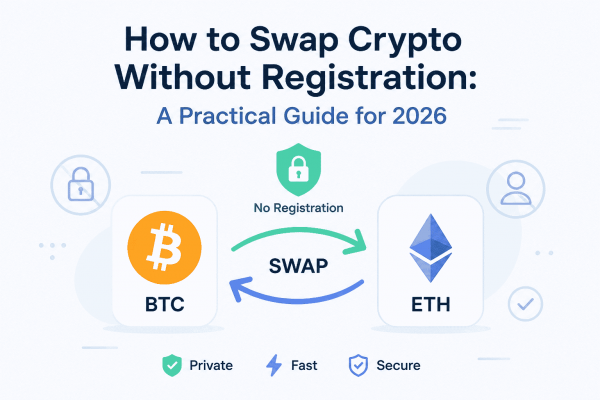
If you need to swap crypto without registration, the answer is direct: you don't have to sign up anywhere. Platforms like BoomChange let you select a coin pair, enter a wallet address, and receive exchanged coins in minutes — no account, no ID upload, no waiting days for approval. But behind that simplicity sits a story worth understanding. In 2026, the shift away from KYC-gated exchanges isn't driven by privacy purists alone. It's driven by millions of ordinary users who've been burned, frozen, or simply worn down by the friction of traditional platforms.
The Moment Everything Freezes
Picture it: it's a Tuesday afternoon. You've been holding a position in ETH, and the market is moving in your direction. You open your exchange app, confirm the swap — and a yellow banner appears. "Your account has been flagged for review. Please upload additional identification documents."
Your funds are locked. The window closes. Three days later, after submitting a passport scan, proof of address, and a selfie holding a handwritten note, you're cleared. The trade is long gone.
This scenario plays out thousands of times every week across centralized platforms. And it's one of the quietest forces pushing users toward services that never ask for any of it.
The Data Behind the Drift
The numbers make the trend hard to dismiss.
According to data from DeFiLlama and Dune Analytics, non-custodial swap volumes surged by over 340% year-over-year, with platforms processing billions in daily volume without requiring users to submit identification documents or create accounts.
In November 2025, one in five crypto spot trades skipped a centralized exchange entirely — the DEX-to-CEX spot ratio hit 21.2%, an all-time high, and non-custodial swap volume climbed more than 340% year-over-year into early 2026.
Self-custody is accelerating alongside it.
Decentralized exchanges processed $4.9 trillion in spot trades during 2025, and their share of spot volume doubled, from 6.9% in January 2024 to 13.6% by January 2026.
About 59% of crypto wallet users now prefer non-custodial wallets, self-custody awareness reached 71% in 2025, and active wallets passed 820 million globally, with self-custody driving most of the growth at 47% year-over-year.
What changed? Partly regulation.
The Markets in Crypto-Assets (MiCA) regulation in Europe, combined with tightening SEC oversight in the United States, has created a compliance-heavy environment for centralized exchanges.
But the sharper catalyst was a series of breaches that revealed what KYC verification really means in practice.
Coinbase disclosed in a May 2025 SEC filing that attackers had accessed the personal data of approximately 70,000 customers — an incident it estimated could cost up to $400 million.
The lesson landed hard: every passport, every selfie, every utility bill you upload is a honeypot you don't control. A platform that never collects your data has nothing to leak.
Google Trends data shows that searches for "no-KYC crypto exchange" have been rising consistently since late 2023.
By 2026, what was once a fringe preference among privacy advocates has become a mainstream behavioral shift.
Who Actually Uses No-Registration Exchanges?
Here's what the editorial narrative on no-KYC platforms consistently gets wrong: it frames users as either paranoid libertarians or bad actors trying to dodge oversight. The actual user base looks nothing like that.
Think of the freelancer in Manila who receives USDT from a client in Germany and needs to swap it to a local stablecoin before the rate shifts. Or the small trader in Lagos who doesn't have a government-issued ID in the format a Binance portal will accept. Or the investor in São Paulo who wants to rebalance a portfolio without handing biometric data to a foreign entity they've never met.
In regions with strict capital controls or growing surveillance, this trend is even more noticeable. Traders are turning to no-KYC platforms not just for convenience, but because access to regulated exchanges is becoming harder. Speed also matters — traders who need to move fast, rotate funds, or test multiple wallets don't want to wait hours or days to get verified. A no-KYC platform makes that friction disappear.
For these users, the appeal of swapping without registration isn't ideological. It's purely practical.
How to Swap Crypto Without Registration — And What to Look For
The mechanics are simple once you find a reliable platform. A typical no-registration swap works like this: select the asset you're sending, select the asset you want to receive, enter your destination wallet address, send funds to the generated deposit address, and collect your exchanged coins. That's the entire flow.
What separates reliable platforms from unreliable ones comes down to a few signals: transparency about rates before you commit (fixed vs. floating), a verifiable track record of completed transactions, and accessible support for edge cases like network delays.
BoomChange processes instant crypto swaps with an average exchange time of 10–20 minutes and a minimum starting amount of $10 — no registration required at any point. For users moving between Bitcoin, Ethereum, Litecoin, and dozens of other pairs, including into fiat-adjacent rails like PayPal and Skrill, the absence of account creation removes the single biggest source of delay in the entire process.
One practical note: no-registration platforms vary in how many asset pairs they support. Before committing to a swap, verify that your specific pair is available and check current liquidity on that route. Most reputable platforms surface this information before you deposit — if they don't, that's worth noticing.
A Structural Shift, Not a Passing Trend
The rise of no-registration crypto exchanges reflects the same forces that gave us self-custody wallets, decentralized lending, and on-chain governance: users burned by centralized intermediaries building workarounds that don't require them.
The more common behavior is a hybrid model: buy crypto through a regulated exchange, transfer to a self-custody wallet, then engage with no-KYC services for specific transactions. This chain of custody gives users compliant entry points while preserving privacy where they value it most — in trading, swaps, and service access.
What's clear is that the average person choosing to swap crypto without registration in 2026 has more options, more awareness, and less patience for unnecessary friction than at any point in this industry's history. The platforms built around that reality — for the user who just wants to swap and move on — are capturing the users that traditional exchanges keep losing to their own compliance overhead.
The question was never whether to register. It was why anyone should have to.