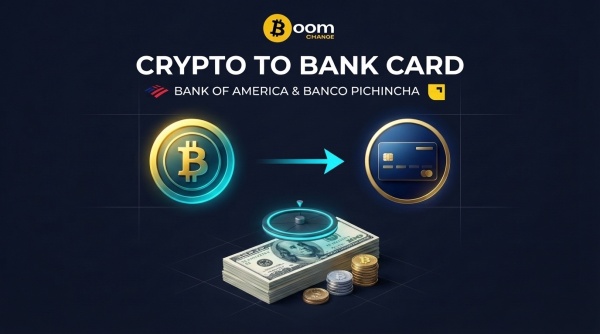
Crypto can live entirely outside the traditional banking system, but most everyday expenses still do not.
You can hold Bitcoin in a personal wallet, keep Ethereum in a self-custody address, receive Solana from another person, or manage other decentralized assets without having a conventional bank account involved. That works well until the money needs to pay for something in the real world.
Rent does not normally accept ETH. A grocery store does not ask for your wallet address. A bank card expects a conventional payment balance.
This creates the practical question many crypto users eventually face: how do you move decentralized digital assets into a bank card or bank account without making the process unnecessarily complicated?
The answer depends on the cryptocurrency, its blockchain, the destination, and the conversion route available to you.
Crypto and Banking Operate on Different Rails
The first thing to understand is that a cryptocurrency and a bank account are not two versions of the same financial product.
Bitcoin exists on the Bitcoin network. Ethereum operates on Ethereum. Solana uses its own blockchain. Other decentralized coins operate on their respective networks and wallets.
Bank cards and bank accounts work through traditional financial infrastructure.
Because of that difference, sending a coin directly to a normal bank account number is generally not how the conversion works. There has to be a conversion point between the crypto asset and the traditional currency destination.
That is where a crypto conversion service can become useful.
Instead of thinking about the transaction as “sending crypto to a bank,” it is more accurate to think about it as:
crypto asset → conversion → traditional-money destination
The destination might be a compatible bank card, a Bank of America account, or an eligible Banco Pichincha account, depending on the available route and account requirements.
Which Coins Can Be Used?
There is no single “decentralized coin” format.
Bitcoin, Ethereum, Litecoin, Solana, XRP, Dogecoin and other assets all have different networks and transaction systems. Even assets with similar names can create problems if the wrong blockchain is selected.
For example, a user may hold an asset in a wallet that supports several networks. Choosing the wrong network during a transfer can result in funds being sent somewhere the receiving system cannot recognize or process.
That is why the conversion screen should always be checked before sending anything.
Look at three things in particular:
- the exact cryptocurrency
- the blockchain network
- the amount that will be received at the destination
The wallet you are sending from must match the deposit instructions provided for the transaction.
Turning a Crypto Balance Into Card-Ready Money
A bank card is often the most familiar destination for someone who wants to spend converted crypto.
The important distinction is that the card itself is usually not receiving a blockchain transaction. The cryptocurrency is converted first, and the resulting traditional currency is directed through the supported payment route.
This can be useful for someone who holds crypto but does not want to maintain a separate exchange account simply for occasional cash-outs.
For example, imagine a freelancer receives several crypto payments during the month. Instead of leaving every payment in a volatile asset, the freelancer can decide how much needs to become everyday spending money and convert that portion.
The same idea applies to personal savings, digital-asset rewards, or proceeds from a crypto transaction.
The conversion should be treated as a separate financial decision from the original crypto transfer.
Using Bank of America as the Destination
Bank of America customers who want to move crypto value into their banking setup need to distinguish between the crypto transaction and the eventual bank transfer.
A conventional Bank of America account does not function as a cryptocurrency wallet. You cannot simply paste a bank account number into a blockchain wallet and send BTC or ETH to it.
Instead, the crypto must first pass through a conversion route that supports the intended banking destination.
Before initiating a transaction, check the receiving details carefully. Account information, currency requirements, eligibility and available payment methods can vary.
This is particularly important when the crypto is being converted into U.S. dollars.
The amount displayed during the conversion process may not be identical to the original crypto value because the cryptocurrency's market price can move and the conversion route may include its own costs.
For larger transactions, checking the final amount before confirming the transfer is especially important.
What About Banco Pichincha?
The same basic principle applies to Banco Pichincha.
Whether the intended destination is an account or another supported banking route, the cryptocurrency does not travel directly onto the bank's traditional payment network. There needs to be a conversion step between the blockchain and the banking system.
This distinction becomes particularly useful for people who receive crypto internationally and ultimately need funds in a conventional financial account.
The exact receiving process can depend on the country, account type, currency and available payment method. Users should therefore rely on the current destination details shown for their particular transaction rather than assuming that every Banco Pichincha account works identically.
Why the Network Matters So Much
A crypto conversion can fail long before the bank destination becomes relevant if the blockchain side is handled incorrectly.
Suppose you have an asset available on more than one network. The conversion service may accept only a specific version for a particular route. Selecting another network simply because it appears in your wallet can create a mismatch.
This is one of the easiest mistakes to avoid.
Before pressing send, compare the deposit network with the network selected in your wallet. Do not rely only on the coin's name.
Fees should also be considered.
Bitcoin transactions have Bitcoin network fees. Ethereum transactions involve Ethereum gas. Solana transactions use Solana's network structure. Other blockchains have their own fee mechanisms.
The cost of sending the asset can therefore affect the practical amount available for conversion.
A Practical Way to Approach the Conversion
The process does not need to begin with transferring your entire wallet balance.
A more cautious approach is to decide how much you actually need to convert.
If you hold $2,000 worth of cryptocurrency but only need $500 for current expenses, there may be little reason to move the entire balance at once.
Start by checking the available conversion route for the amount you want to use. Services such as Boomchange can be used to explore available crypto-to-payment conversion options before you commit the funds.
Once the route is selected, carefully review the asset, network, destination details and expected amount.
Only then should the crypto be sent to the provided deposit address.
This approach also gives you an opportunity to spot a network mismatch or an unexpectedly high cost before the transaction becomes irreversible.
Don't Ignore the Value of the Crypto During the Process
Crypto prices can change while you are deciding what to do with your funds.
This is particularly relevant with assets such as BTC and ETH, where a change in market price can alter the fiat value of a transaction even when the number of coins remains exactly the same.
For that reason, the amount you expect to receive should be checked at the time of conversion rather than calculated from an older market price.
There can also be a difference between the market value of the cryptocurrency and the final amount reaching the destination because conversion costs and other transaction expenses may apply.
The displayed final amount is therefore more useful than a simple calculation based on the current coin price.
Self-Custody Makes Security Your Responsibility
Decentralized crypto gives users control over their assets, but that control comes with responsibility.
A private key or recovery phrase should never be given to someone claiming to process a conversion. A legitimate transaction requires the appropriate wallet address and transaction information, not access to the wallet itself.
Before sending a significant amount, verify the deposit address directly from the conversion interface you are using.
Avoid copying addresses from old messages or relying on screenshots.
If malware or a clipboard attack changes an address before you send the transaction, the funds may end up somewhere completely different.
For this reason, taking an extra minute to verify the destination can be more valuable than rushing to complete the transaction.
Bank Card, Bank of America or Banco Pichincha?
These destinations serve different practical needs.
A bank card can make sense when the main objective is turning crypto into money that can eventually be used for everyday purchases.
Bank of America may be relevant to someone who already maintains a U.S. banking relationship and wants converted funds to reach that traditional financial environment.
Banco Pichincha can be relevant to users who already operate within its banking ecosystem and need a conventional destination rather than leaving their funds in crypto.
The right route depends on the account you actually have, the currency involved, the crypto you hold and which conversion methods are available at the time.
There is no need to treat the bank destination as part of the blockchain transaction itself. It is the final stage of a process that starts with the digital asset and passes through a conversion layer.
The Main Thing to Get Right
Converting decentralized crypto into traditional banking money is less about finding a complicated technical trick and more about keeping the two financial systems clearly separated.
Your crypto remains on its blockchain until it reaches the conversion stage. The banking destination belongs to a different payment system.
Once that distinction is understood, the process becomes easier to manage.
Choose the asset carefully. Confirm the network. Check the destination information. Review the expected payout. Account for transaction costs. Then send only the amount you actually intend to convert.
For users looking for a bridge between decentralized assets and conventional payment destinations, Boomchange can be part of that process, depending on the route available for the selected cryptocurrency and destination.
The goal is straightforward: take crypto that exists on a decentralized network and turn the portion you need into money that can work within your everyday financial system.