September is ending with an unusual mix of signals across global markets.
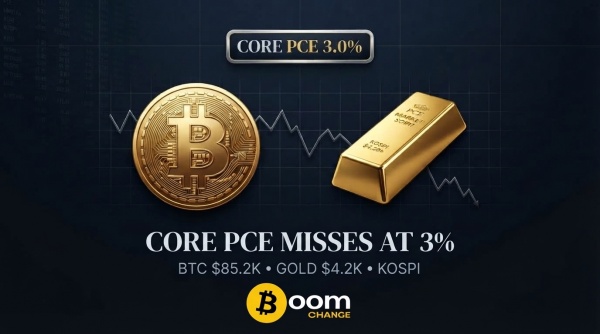
U.S. inflation came in softer than expected, Bitcoin pushed back above $85,200, gold moved through $4,200, and South Korea's KOSPI recorded its weakest quarter since the market turmoil of early 2020.
Those moves are happening against a complicated economic backdrop. Inflation is still above the Federal Reserve's long-term target, consumer spending remains strong, oil prices have climbed, and bond yields have stayed elevated. At the same time, investors are reassessing how much additional tightening the U.S. economy may actually face.
For cryptocurrency markets, that combination makes the latest PCE report particularly important.
Core PCE Falls Short of Expectations
The latest U.S. data showed core Personal Consumption Expenditures inflation rising 3.0% over the year through August. That was below the approximately 3.3% economists had been expecting.
The revision to July was also significant. The previous 3.3% reading was lowered to 3.0%, meaning the underlying inflation picture for the summer was weaker than initially reported.
Monthly core PCE increased 0.2% in August. The headline PCE index rose 0.3% for the month and was 3.4% higher than a year earlier.
The figures do not represent a return to the Federal Reserve's 2% inflation objective. Core inflation remains meaningfully above that level. What changed was the direction of the latest data and, particularly, the downward revision to the previous month.
That gave financial markets another reason to reconsider expectations for interest rates.
There was also evidence that American consumers were not pulling back dramatically. Consumer spending increased 0.9% in August, considerably stronger than the previous month's revised 0.1% increase.
That leaves policymakers dealing with two different signals: price growth has moderated somewhat, while household spending continues to show considerable strength.
Bitcoin Reclaims the $85,000 Area
Bitcoin moved above $85,200 as traders processed the inflation report and reassessed expectations surrounding Federal Reserve policy.
The reaction fits a pattern that has become increasingly familiar in crypto markets. Bitcoin remains a digital asset, but its short-term price action can be heavily influenced by developments in interest rates, the U.S. dollar, liquidity and broader investor risk appetite.
A softer inflation number can matter because it reduces some of the pressure for additional monetary tightening.
Following the latest data, expectations for an October Federal Reserve rate increase declined. The change in expectations was accompanied by moves in Treasury yields and the dollar, creating a more supportive short-term environment for risk assets.
Bitcoin's move above $85,000 therefore deserves attention, but the level itself does not establish a new long-term trend.
Crypto markets can change direction quickly when leverage, derivatives positioning or macroeconomic expectations shift. Traders will still be watching ETF activity, liquidity conditions and subsequent economic releases.
For people who already hold cryptocurrency, these moves also highlight an increasingly practical issue: market prices are only one part of the process. Converting digital assets into usable funds is another.
Services such as Boomchange are relevant to that part of the crypto cycle because users may want to move from crypto holdings into a preferred payment method instead of remaining exposed to the market indefinitely.
Gold Pushes Through $4,200
Gold responded positively to the inflation figures as well.
Spot gold moved above $4,200 per ounce, while U.S. gold futures climbed further. The weaker dollar following the inflation release provided another source of support for the precious metal.
Gold and Bitcoin are often discussed together because both can attract investors looking beyond traditional cash and equity exposure, but their market structures remain very different.
Gold has a much longer history as a reserve and defensive asset. Bitcoin is still considerably more volatile and remains closely connected to crypto-specific factors such as exchange flows, leverage and digital-asset liquidity.
The interesting development is that both assets reacted positively around the same macroeconomic event.
There is an important qualification, however. Gold's move above $4,200 came after a difficult September. The metal's short-term rebound therefore needs to be separated from its broader monthly performance.
A strong session does not automatically mean the previous trend has been reversed.
KOSPI Records Its Worst Quarter Since 2020
The picture looked very different in South Korea.
The KOSPI lost roughly 19% during the third quarter, marking its steepest quarterly decline since the first quarter of 2020.
The benchmark finished September 30 near 6,838 points after another daily decline.
South Korea's market has substantial exposure to semiconductor companies, making it particularly sensitive to changes in technology valuations and expectations surrounding artificial-intelligence investment.
That exposure became a major source of volatility during the quarter.
The KOSPI's quarterly fall also demonstrates why different asset classes can respond very differently to the same global environment. While Bitcoin and gold received support from changing rate expectations, Korean equities were dealing with pressure across technology shares, bonds and other parts of the global investment landscape.
Even after the sharp quarterly decline, the KOSPI remained substantially higher than it had been one year earlier.
The time period therefore matters when interpreting market statistics.
High Bond Yields Keep the Picture Complicated
The latest inflation report may have reduced some concerns about another immediate rate increase, but the broader interest-rate environment has not suddenly become easy.
U.S. Treasury yields have remained elevated, while oil prices have also risen considerably during the year.
Expensive energy can complicate the inflation outlook because higher fuel and transportation costs can eventually affect other parts of the economy.
This creates a difficult combination for investors.
Lower-than-expected core inflation points toward less pressure from monetary policy. Strong consumer spending suggests economic activity remains resilient. Higher oil prices can keep inflation concerns alive. Elevated bond yields can continue competing with riskier investments for capital.
Markets therefore have several competing signals to process at once.
What This Could Mean for Crypto Users
For cryptocurrency investors, the most important development may not be any single price level.
Instead, the bigger issue is how macroeconomic conditions influence the path of capital through digital assets.
If expectations for tighter monetary policy continue to decline, risk appetite could change. If inflation accelerates again, the opposite could happen. Bitcoin can react sharply to either scenario.
That is why conversion platforms can become useful during periods of increased volatility.
Someone holding BTC, ETH, USDT or another cryptocurrency may eventually want to move part of that balance into a payment service rather than continue holding the asset through every market swing. Boomchange provides a route for users looking to exchange crypto funds into preferred payment systems.
The practical advantage is that crypto activity does not have to stop at buying or holding an asset. For some users, the final step is turning digital funds into money they can actually use for everyday expenses, online services or business activity.
The Final Market Signal From September
September closes with no simple story.
Core PCE came in below expectations and July was revised lower. Bitcoin climbed back above $85,200. Gold broke above $4,200. Meanwhile, South Korea's KOSPI experienced its worst quarter since 2020.
Each market is responding to its own combination of factors, but interest-rate expectations remain one of the common threads.
For Bitcoin, the immediate question is whether the move above $85,000 can hold as investors receive more economic data. For gold, attention will remain on inflation, real yields and the dollar. For equities, the KOSPI's performance shows how quickly concentrated technology exposure can become a source of volatility.
The next few economic releases will provide more information, but September has already demonstrated how quickly the market narrative can change.
For crypto users, that means watching price charts is only part of the picture. Understanding the macroeconomic backdrop — and having a practical way to move crypto into preferred financial channels when needed — has become increasingly relevant as digital assets become more integrated with the wider financial system.