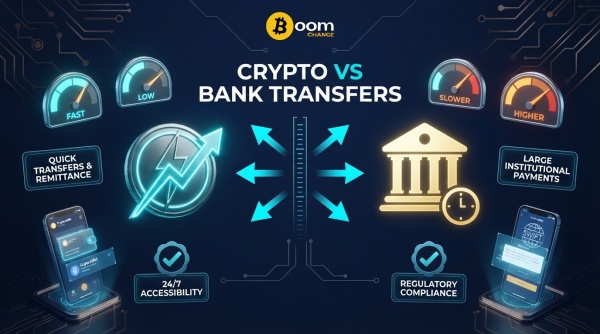
If you've sent an international bank wire recently, you know the experience: fill out a form, wait for processing, pay $25–50, hope it arrives in 3–5 business days, and pray the currency conversion rate isn't too punishing. Then you watch a colleague send $2,000 in USDT TRC-20 and have it confirmed in 47 seconds.
The gap between those two experiences has gotten hard to ignore. But it's not all one-sided. Here's the honest comparison.
Speed: The Most Obvious Difference
Bank wire: International SWIFT transfers typically take 2–5 business days. Same-day processing is possible within some domestic banking networks (like SEPA in Europe or ACH in the US) but not reliably for international transfers. Start a wire on Friday afternoon and it often doesn't process until Monday.
Crypto: USDT TRC-20 confirms in under 60 seconds. Bitcoin takes 10–60 minutes depending on network congestion and the fee you paid. Ethereum takes 1–15 minutes. Solana takes 1–3 seconds. Crypto operates 24/7, 365 days a year — there are no banking hours, no weekend delays, no national holiday pauses.
The speed difference is structural, not marginal. Crypto doesn't just slightly outperform bank wires — it operates on an entirely different time scale.
Cost: Usually Lower for Crypto, But With Caveats
International bank wire: Sending fees range from $25 to $50 at most US and European banks. The receiving institution often charges an additional fee ($10–30). And the exchange rate markup — the gap between the mid-market rate and what the bank charges you — adds another 2–4% on top of stated fees.
A $1,000 wire transfer internationally can realistically cost you $50–90 in total when you account for all three layers.
Crypto: USDT TRC-20 transaction: a few cents in network fees. Bitcoin: $1–20 depending on congestion. Ethereum: $1–50 depending on gas. Then there's the exchange margin when converting crypto to fiat — typically 1–3% on a well-priced instant exchange.
For a $1,000 transfer via USDT TRC-20 through an instant exchange like Boomchange to PayPal: total effective cost is typically $20–40 in exchange margin, with essentially no network fee. That's cheaper than most bank wires — often dramatically so.
The caveat: if you're converting volatile crypto (BTC, ETH) rather than a stablecoin, price movement during the transaction adds another cost variable. USDT eliminates that.
The Exchange Rate Reality
Banks don't give you the mid-market rate. They give you a marked-up rate and pocket the difference. PayPal's currency conversion markup runs 3–4% above mid-market. Most banks are similar.
Crypto-to-payment-platform conversions via services like Boomchange reflect market rates at the time of conversion. The margin is present — it's built into the quoted output — but it's disclosed upfront and typically narrower than a bank's currency conversion spread.
For recipients in different countries converting the incoming payment to local currency, this matters. A Wise balance, for example, converts at mid-market rates — measurably better than what a bank offers for the same conversion.
Security: Different Risk Profiles, Not One Being Safer
Bank wire security: Highly regulated, with fraud protection and reversal mechanisms. If a fraudulent wire is caught quickly, recovery is sometimes possible. The infrastructure is battle-tested over decades.
The downside: banks are centralized. Data breaches, account freezes, and government-mandated transaction holds are real risks. And in countries with unstable banking systems, "the bank holds your money" is not always a comfort.
Crypto security: Irreversible by design. A confirmed blockchain transaction cannot be recalled. This eliminates chargebacks (good for merchants) but also eliminates error correction (bad if you send to the wrong address). Security depends heavily on user practice.
On the plus side: non-custodial crypto transactions don't expose your banking credentials to third parties. And a USDT TRC-20 transfer to a Payoneer account via Boomchange doesn't require the recipient to share banking details at all.
When Bank Wire Is Still the Right Choice
Very large amounts. Wire transfers have established compliance frameworks for large transfers. For a $500,000 business payment, a wire with documented compliance history is often more appropriate than a crypto conversion.
Recipients who can't use crypto. Not everyone is set up to receive crypto or to use a payment platform that receives it. Traditional bank accounts remain the most universally accessible destination.
Regulated business contexts. Some regulatory environments require bank wire documentation for audit trails. Crypto transactions, while traceable on-chain, don't produce the institutional paper trail some businesses need.
When Crypto Is Clearly Better
Speed is critical. Someone needs money today — not in five business days.
Smaller-to-medium international transfers ($50–$5,000). The fee economics work clearly in crypto's favor at this range.
Recipients in countries with limited banking access. Crypto-to-payment-platform conversions reach markets that SWIFT transfers handle poorly or expensively.
24/7 transfers. Sending on a Friday night or Sunday morning. Bank wires don't process; crypto does.