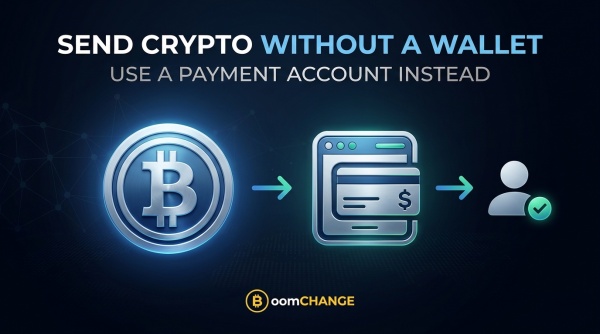
You have crypto. The person you're trying to pay doesn't.
It sounds simple until you actually try to do it. Bitcoin, Ethereum, USDT, SOL, and other cryptocurrencies need a blockchain destination. In most cases, that means a wallet address controlled by the person receiving the funds.
But what if they have never used crypto? They don't have a wallet, don't know what a seed phrase is, and probably don't want a crash course in blockchain technology just to receive a payment.
There is another way to approach it.
Instead of making the recipient become a crypto user, you can look at what payment service they already use. If a suitable route is available, Boomchange can sit between your cryptocurrency and the recipient's existing payment account.
You can check the available options through Boomchange.
Why You Can't Simply Send Crypto Without a Wallet
A blockchain doesn't recognize people in the same way a payment app does.
It doesn't know that an email address belongs to your friend or that a particular phone number belongs to your client. A blockchain transaction needs a compatible destination address.
That's why you normally can't take Bitcoin and send it to someone's email address just because they use that email for PayPal.
Creating a wallet for them isn't always a great solution either. If you create the wallet and keep the recovery phrase, you're still controlling the funds. Handing the phrase to someone afterward also creates a security problem if they don't understand how wallet recovery works.
For a person who simply needs to receive money, there may be no reason to introduce all of that complexity.
Start With the Payment Account They Already Have
A better question is not:
“What's your crypto wallet address?”
Instead, ask:
“Where can you receive money?”
Maybe they already use PayPal. Perhaps they have Cash App, Wise, Skrill, a bank account, or another supported payment service.
That changes the problem considerably.
Rather than trying to send cryptocurrency directly to someone who doesn't have a wallet, you can use a supported exchange route to turn your crypto into funds that can reach an account they already understand.
The general flow is:
Your crypto → Boomchange → payment route → recipient
The recipient doesn't necessarily need to know anything about the blockchain side of the transaction.
How Boomchange Can Bridge the Two Sides
This is where Boomchange becomes useful.
Suppose you have USDT in your wallet and the person you're paying doesn't own any crypto. You can check whether the relevant crypto-to-payment route is currently available through Boomchange.
If it is, you select the cryptocurrency you're sending and the supported destination. The exchange interface provides the transaction details, including where the cryptocurrency needs to be sent.
You then send your crypto to the provided deposit address.
The recipient isn't receiving the original cryptocurrency directly. The exchange process handles the crypto side, while the destination receives the corresponding funds through the selected payment route.
That distinction is important because a traditional payment account and a blockchain wallet are not interchangeable.
For people who frequently need to move cryptocurrency toward conventional payment systems, the available routes can be checked through Boomchange crypto exchange before starting a transaction.
Get the Recipient's Information First
Don't start the transaction and then message the recipient asking where they want the money.
Get that information beforehand.
Ask them which payment service they want to use and have them provide the exact information required for receiving funds.
Depending on the service, that might be an email address, username, phone number, bank information, or another identifier.
Check it carefully.
A typo in an email address or username can create unnecessary problems. If you're sending a meaningful amount, ask the recipient to confirm the information before you submit the transaction.
There's another important rule here: don't ask for passwords, PINs, authentication codes, or recovery phrases. Those are not normal details someone needs to provide simply to receive money.
What If the Recipient Has No Payment Account Either?
Then you have fewer options, but you're not necessarily stuck.
One possibility is to help the person establish a payment account that is available in their country. Once the account exists, you can see whether the required route is supported.
The other possibility is setting up a crypto wallet.
If the recipient genuinely wants to own cryptocurrency, this may actually be the better long-term choice. But the wallet should belong to them. They should create or take control of the recovery information and store it themselves.
Don't keep their seed phrase “for safekeeping.” That defeats the purpose of giving them control over the wallet.
For someone who just needs to receive a one-time payment, however, a familiar payment account may be much easier.
Sending Crypto as a Gift
Imagine you want to give someone $100 worth of crypto for their birthday.
They don't have a wallet.
You have two very different choices.
You could give them $100 worth of cryptocurrency and help them learn how to use a wallet. That means teaching them about addresses, recovery phrases, transaction fees, and basic security.
Or you could give them $100 through a payment service they already use.
The second option may be more practical if the point of the gift is simply giving them money rather than introducing them to cryptocurrency.
The important distinction is what you're actually trying to give: crypto ownership or spending value.
Don't Keep Control of Someone Else's Wallet
There is a common shortcut that looks convenient but creates a poor security arrangement.
You create a wallet, put the crypto inside, and give the recipient the wallet information.
If you still have the recovery phrase, you still have the ability to access the funds.
That's not genuine self-custody for the recipient.
If the goal is for someone else to own cryptocurrency, they should ultimately control their own recovery information. Seed phrases should never be posted publicly, stored casually in chat, or handed to an exchange service.
And if someone claiming to represent an exchange asks for your seed phrase, treat that as a serious warning sign.
Pay Attention to the Network
Once you've decided to use a crypto-to-payment route, there is still a technical detail you shouldn't overlook: the blockchain network.
Some assets exist on multiple networks. USDT is a familiar example, as it can be found on networks including Ethereum, TRON, and BNB Smart Chain.
The network used for your transaction has to match the instructions provided for the deposit.
Don't assume that an address is automatically compatible with every version of an asset.
Before sending, compare the cryptocurrency, network, deposit address, amount, and any additional information requested.
If you're using a route for the first time, a small test transaction can also be a reasonable precaution before moving a larger balance.
What Does the Recipient Actually Experience?
For the recipient, the process can be surprisingly ordinary.
They may never interact with a blockchain at all.
You start with cryptocurrency. The exchange stage handles the conversion, and the destination payment service receives the resulting funds through its applicable payment infrastructure.
From their perspective, they simply receive money through the account they already use.
That's one of the main reasons this approach can make sense for people who aren't interested in crypto themselves.
Don't Forget About the Exchange Rate
The amount of crypto you send isn't necessarily the amount the recipient will see.
The final figure can be affected by the current cryptocurrency price, the exchange rate offered for the transaction, network costs, and applicable service charges.
This is particularly important with volatile cryptocurrencies.
If you calculated the expected amount several hours earlier, don't assume that calculation is still accurate. Review the actual quote shown for the transaction before approving it.
A Simple Test Can Prevent a Bigger Problem
If you've never used a particular crypto-to-payment route before, start with a smaller amount if practical.
That gives you a chance to verify that the deposit address is correct, the network is supported, the exchange process works as expected, and the destination information was entered properly.
Once the first transaction is successful, you can decide whether to move the rest.
This isn't about making crypto complicated. It's simply a sensible way to reduce the consequences of a mistake.
The Practical Solution
Sending cryptocurrency to someone who doesn't have a wallet doesn't necessarily mean forcing them to create one.
First find out where they can already receive money.
If they have a supported payment account, check whether Boomchange offers a route connecting your cryptocurrency with that destination. If the route is available, the crypto can be exchanged before the resulting funds are sent through the applicable payment system.
The basic idea is straightforward:
You have crypto. They have a payment account. Boomchange connects the two sides.
If the recipient wants to learn about cryptocurrency and hold the asset themselves, setting up their own wallet makes sense. If they simply want to receive money, using a payment account they already understand can be considerably easier.
Whatever route you use, verify the recipient's details, check the blockchain network, review the exchange rate and fees, and never share a wallet recovery phrase.